

Most people who state “slots ate my money in ten minutes” did not get “unlucky,” but simply showed up without a plan. They put in $100, chose a bet that felt about right, spun and watched the balance dwindle while still waiting for the coffee to cool. I’ve done it. Most regular players have. There’s no secret system. It’s slot bankroll management: decide how much money you can afford to lose, break that down into Session budgets & match bet size to the game’s volatility and play time.
I’ll outline how to determine an appropriate slot bankroll that will allow you to make it through a Session. This includes using actual figures, the common guidelines (1% rule, 200x/250x guidelines), and the stop loss/winnings limit habits that are significantly more important than formulas. Prior to getting into details, there’s something that needs to be said. None of the information provided below will beat the house edge. A bankroll management strategy determines how long your money will last and how much the ups-and-downs will hurt. It does not determine if you win.
What does a Session bankroll actually mean?
There are two numbers to consider separately. Blending these together is the beginning of a great deal of trouble.
Your total gambling bankroll refers to all the money you’re setting aside for slots over some type of time frame (usually a month). Your Session bankroll (Session budget) is the portion of your total bankroll you are going to take to one sitting. For example, if your total monthly bankroll for slots is $200 and you intend to gamble four times during the course of the month, then each Session is limited to $50. That $50 represents the only funds available for betting tonight. It’s not ‘the first $50 of the $200’.
Using this perspective provides two valuable benefits. First, it sets a cap on potential losses resulting from a single terrible evening. Second, it provides a fixed Number to base decisions regarding your bet per spin. All bankroll calculators, formulas and rules outlined in this section begin with your Session bankroll, not your total bankroll.
Bankroll based on disposable income
It seems obvious that you should only fund your overall bankroll with disposable income. However, it seems like many people forget this. Your total bankroll should be funded from discretionary income — entertainment expense dollars. I.e., similar categories as concert tickets, take-out, or a streaming service. Your total bankroll should not be funded from whatever cash remains in your account after covering all expenses such as rent/mortgage, utilities, credit card/min payment, etc. … Savings, etc.
Here is a simple test I find helpful: imagine losing the entire amount of your total monthly bankroll within a week. If the mere thought causes you discomfort, you will be fine. If you are now thinking about how to recoup that amount, you may have chosen too large a monthly bankroll amount. Slots will return less than what you deposited over time. A game with 96% RTP keeps approximately 4% of the aggregate amount deposited on average; therefore, you should treat deposits as spent money. Any amount you take home is considered a bonus.
To ensure you stay under your monthly limit as you log in online, place this Number in the deposit limits tool prior to doing anything else. Most licensed online gaming sites provide tools for limiting your daily, weekly, or monthly deposits. Some also include options for limiting losses, as well as pop-up reminders that alert you to how long you have been playing. Use them. It is much simpler to adhere to a budget established by the website than to fight yourself into establishing one at midnight.
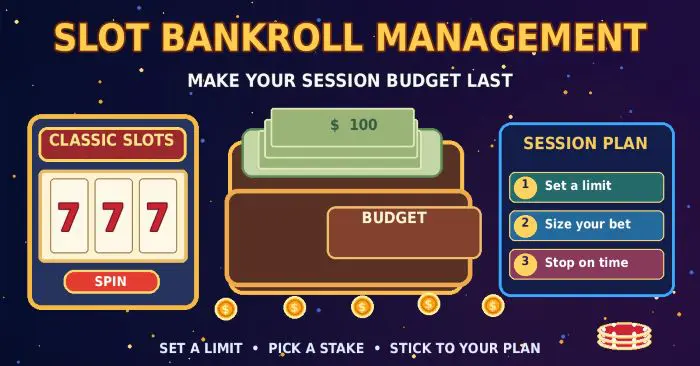
Divide total monthly amount into Session budgets
The primary method of determining slot bankrolls is relatively straightforward:
Session budget = total bankroll / Number of sessions
As an example, with a $300/monthly allocation and six planned sessions, you can allocate $50/Session. Alternatively, with $300 and only three sessions scheduled, you could allocate $100/Session. Neither approach is inherently superior. More frequent and lower allocations enable larger bets per spin or allow you to play high volatility slots with confidence. Less frequent and larger allocations enable fewer sessions and larger stakes per spin.
When planning how frequently you will actually participate in gaming sessions, be accurate. Many people lose their monthly budgets by the 12th because they initially intended to participate in four sessions and subsequently participated in nine.
A principle i regard as non-negotiable: unused Session budgets revert back to the total amount allocated for bankingrol management and losses cannot be borrowed from future sessions. Once a Session has exhausted its budget ($50 in our example), that Session is complete. The unused $30 (for example) from Friday’s Session cannot be used towards Tuesday’s Session budget.
Determine bet per spin by determining coverage spins
Determining the correct bet per spin is where sessions either succeed or fail.
Once you establish your Session budget, bet per spin determines nearly everything about how the night progresses. The relationship operates both ways:
Spins = Session budget / bet per spin
Bet per spin = Session budget / desired # of spins
An example illustrating this concept would be a $100 Session @ $1/spin provides 100 spins of coverage. An identical $100 Session @ $0.40/spin offers 250 spins of coverage. This is essentially the entire mechanism. Most people select the game and then the bet per spin based upon those selections when the process should be reversed: select the desired Number of spins and then allow the mathematics to dictate your bet per spin.
Volatility is important when determining bankroll
If there was only one idea to extract from this article — extracting this one idea would be sufficient — it would be: your appropriate slot bankroll is dependent upon volatility substantially more than RTP.
RTP indicates your average return rate over a prolonged timeframe (millions of spins). Volatility (variance) indicates how irregular your results will be throughout the duration of the Session. Two slots can possess virtually identical RTP values (both 96%). One pays small rewards fairly consistently, whereas the other pays absolutely nothing for multiple hours before providing a reward of 400x. Throughout a single Session involving several hundred spins, volatility will dictate your experience substantially more than a difference of one to two points in RTP will.
Low volatility games
Low-volatility games present infrequent large winning opportunities. Low-volatility games pay frequently but provide small returns. As opposed to high-volatility games where one can lose 80%+ of their bankroll quickly due to infrequent large winnings, low-volatility games will gradually eat away at your bankroll. Betting 1% to 2% of your Session bankroll is acceptable for low-volatility games. Furthermore, 100-150 spins of coverage typically represent adequate protection for low-volatility games. These are ideal choices for small budgets or those seeking an extended leisurely gaming Session. The drawback of low-volatility games is they rarely produce significant winning opportunities and cap maximum winning amounts at $500-$750 on average.
Mid-volatility games
The majority of mainstream video slots fall somewhere in-between low- and high-volatility slots. Mid-volatility slots generally pay small amounts in addition to periodic bonuses. For mid-volatility games, 1% per spin and 200-250 spins of coverage is a suitable combination. If unsure where a specific game falls on the spectrum of volatility, err on the side of caution and utilize 250 spins as the baseline.
Common mistakes resulting in short painful sessions
Almost all short painful sessions I’ve experienced personally or witnessed others experience stem from one or more of the following factors: players choose a game prior to selecting their bet size and let a high minimum stake dictate their spin count; players play high-volatility slots using a budget created for low-volatility games; players increase their bet size immediately following a loss or immediately following a win; players engage in turbo mode/autoplay with no stopping criteria; and players view their Session budget as a starting deposit rather than a hard cap.
Another factor that receives little attention: playing with no time limit while fatigued
Late-evening gaming sessions appear to generate longer/greater volume/faster decision-making processes than One would normally exhibit during daytime gaming sessions. If you change only One habit — refrain from initiating gaming sessions past a certain hour — you’ll likely see improved gaming experiences.
Sample Session from start to finish
Below illustrates how this might look in practice: your total monthly entitlement for slots is $200, and you anticipate participating in four gaming sessions during the course of the month. Therefore, your Session entitlement is $50 per Session.
You’d like to play a medium-volatility video slot with a min bet of $0.10 and RTP of 96%. You wish to achieve 250 spins of coverage for your Session, thus dividing $50 by 250 yields a bet-per-spin value of $0.20. At approximately 10 spins/minute via manual operation, that equates to roughly 25 minutes of playtime prior to recycling wins; however, due to various factors, the true playtime may be closer to 40 minutes. The approximate loss expectation for this Session is roughly $0.20 * 250 * 4% = $2; however, actual loss expectations will range widely above/below this estimate.
Prior to commencing spinning activity, you designate a stop-loss condition equal to the total Session budget ($50); establish a win limit condition at +$40; and set a timer for 45 minutes. You operate in manual mode and disable turbo mode. After reaching halfway through the session, you have reduced your balance to $22 and have yet to receive a bonus award. You do not increase your bet size. Continue spinning at $0.20 until either your balance reaches zero or your timer expires.
If you reach a feature award and accumulate an additional $53 in winnings (you’ve exceeded your win limit), lock in $70 and continue playing with the remaining $25 at $0.20 until that is depleted or time expires.
That is an entire gaming Session — not complicated in any way — simply predetermined numbers that were followed. That is what enables a slot bankroll to endure through a gaming Session — ultimately, it allows you to maintain slots as an entertainment option vs. an obligation over an extended timeframe (i.e., months or years).